
Best Irrigation Protocol in Endodontics: What Dentists Use for Successful Root Canals
Root Canal Irrigation & Disinfection Process
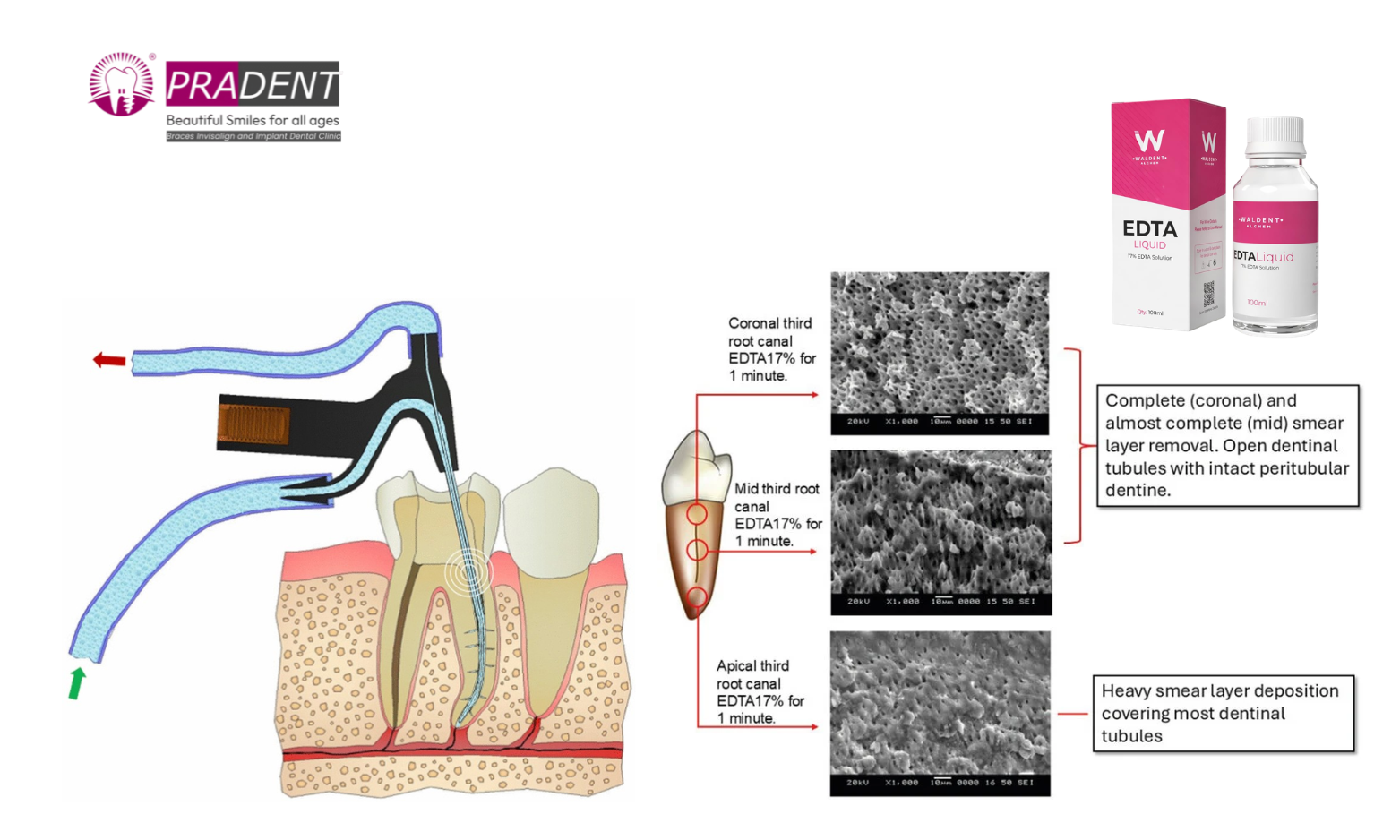
Introduction: Why Irrigation is the Key to Root Canal Success
When it comes to root canal treatment, most patients think the procedure is simply about removing the infected pulp and filling the tooth. However, what truly determines the success or failure of a root canal lies in one critical step — irrigation.
👉 So, what is the best irrigation protocol in endodontics?
In simple terms, it’s a carefully designed sequence of irrigating solutions and techniques used to disinfect, clean, and prepare the root canal system before sealing it.
Modern endodontics emphasizes that mechanical cleaning alone is not enough. Bacteria, biofilms, and tissue remnants often remain deep inside complex canal anatomy. This is where advanced irrigation protocols come into play.
In this blog, we’ll break down the best irrigation protocol used by dentists today, combining scientific principles with practical clinical application.
What is Root Canal Irrigation?
Root canal irrigation is the process of flushing the canal system with antimicrobial and tissue-dissolving solutions during treatment.
Primary Goals of Irrigation:
- Eliminate bacteria and biofilms
- Dissolve organic tissue
- Remove debris created during instrumentation
- Eliminate the smear layer
- Disinfect inaccessible areas
👉 Without proper irrigation, even a well-shaped canal can fail.
Why Irrigation is Critical in Endodontics
The root canal system is highly complex, with:
- Lateral canals
- Isthmuses
- Apical deltas
Mechanical instruments can only clean about 60–70% of the canal walls.
👉 The remaining areas depend entirely on effective irrigation.
Key Insight:
“Irrigation is not an optional step — it is the backbone of successful root canal therapy.”
Components of the Ideal Irrigation Protocol
An effective irrigation protocol must achieve:
Antimicrobial Action
Destroy bacteria and biofilms.
Tissue Dissolution
Remove necrotic pulp tissue.
Smear Layer Removal
Expose dentinal tubules for better disinfection.
Penetration
Reach complex anatomy.
Common Irrigation Solutions Used in Endodontics
Sodium Hypochlorite (NaOCl)
👉 Gold standard irrigant
Functions:
- Strong antimicrobial
- Dissolves organic tissue
- Breaks down biofilm
Concentration:
- Typically 0.5% to 5.25%
Advantages:
- Highly effective
- Fast-acting
Limitations:
- Cytotoxic if extruded beyond apex
EDTA (Ethylenediaminetetraacetic Acid)
👉 Used for smear layer removal
Functions:
- Removes inorganic debris
- Opens dentinal tubules
Typical Use:
- 17% EDTA for 1 minute
Chlorhexidine (CHX)
👉 Alternative antimicrobial irrigant
Functions:
- Broad-spectrum antimicrobial
- Substantivity (long-lasting effect)
Limitation:
- Cannot dissolve tissue
Saline or Distilled Water
👉 Used as a flushing agent
- Dilutes other irrigants
- Removes debris
Best Irrigation Protocol (Step-by-Step Clinical Approach)
Here’s the standard gold protocol followed by modern endodontists:
Step 1 – Initial Irrigation with Sodium Hypochlorite
- Begin with NaOCl during access opening
- Continuous irrigation during instrumentation
👉 Ensures early disinfection
Step 2 – Copious Irrigation During Shaping
- Frequent irrigation after each file
- Maintains cleanliness
👉 Prevents debris accumulation
Step 3 – Activation of Irrigants
Methods:
- Sonic activation
- Ultrasonic activation
- Manual dynamic agitation
👉 Enhances penetration and effectiveness
Step 4 – EDTA for Smear Layer Removal
- Apply 17% EDTA for 1 minute
- Removes smear layer
👉 Opens dentinal tubules
Step 5 – Final Flush with Sodium Hypochlorite
- Reintroduce NaOCl
- Removes exposed organic debris
Step 6 – Optional Chlorhexidine Final Rinse
- Provides long-term antimicrobial effect
⚠️ Avoid mixing NaOCl and CHX directly (forms precipitate)
Advanced Irrigation Techniques in Modern Endodontics
Ultrasonic Irrigation
- Uses ultrasonic energy
- Improves cleaning efficiency
Sonic Activation
- Gentle agitation
- Enhances irrigant flow
Laser-Assisted Irrigation
- Advanced disinfection
- Deep penetration
Negative Pressure Systems
- Prevent irrigant extrusion
- Safer apical cleaning
Factors Affecting Irrigation Success
Volume of Irrigant
More volume = better cleaning
Contact Time
Longer exposure improves effectiveness
Temperature
Warm NaOCl increases tissue dissolution
Needle Design
Side-vented needles improve safety
Common Mistakes in Irrigation Protocol
- Using low volume of irrigant
- Skipping smear layer removal
- Not activating irrigants
- Improper sequence of solutions
- Risky apical extrusion
👉 These mistakes can lead to treatment failure.
Clinical Outcomes: Why Protocol Matters
Studies show that proper irrigation:
- Reduces bacterial load significantly
- Improves healing rates
- Decreases post-treatment complications
👉 A well-executed irrigation protocol = long-term success
Patient Perspective: Why This Matters to You
For patients, effective irrigation means:
- Less chance of reinfection
- Reduced pain after treatment
- Faster healing
- Higher success rate
👉 It directly impacts your treatment outcome and comfort
Role of Expertise in Irrigation Protocol
A skilled dentist understands:
- Proper sequence
- Correct concentrations
- Safe techniques
Advanced care under experts like Dr. Prachi Adsul Chithari ensures:
- Precision
- Safety
- Better results
FAQs – Root Canal Irrigation
Which is the best irrigant in root canal treatment?
Sodium hypochlorite is considered the gold standard.
Why is EDTA used in root canal treatment?
It removes the smear layer and opens dentinal tubules.
Can irrigation alone clean the canal?
No, it must be combined with mechanical instrumentation.
Is irrigation painful?
No, it is a painless part of the procedure.
What happens if irrigation is not done properly?
It can lead to infection, failure, and retreatment.
Conclusion: The Science Behind a Successful Root Canal
The success of root canal treatment doesn’t just depend on filling the canal—it depends on how well it is cleaned and disinfected beforehand.
The best irrigation protocol combines:
- The right solutions
- Proper sequence
- Advanced activation techniques
👉 Modern dentistry proves that effective irrigation is the foundation of successful endodontic treatment.